
 English
 中文简体
中文简体 русский
When evaluating asynchronous three phase motor versus permanent synchronous motor, load response is a key consideration. Asynchronous motors perform well in steady, predictable conditions, while PMSMs excel in variable-load or precision-driven environments due to their stable torque, constant speed, and high efficiency. Zhejiang Hechao Motor Co., Ltd. manufactures both types, allowing industries to select motors that match operational demands and achieve reliable, energy-efficient performance.
1. Load Response Characteristics
Asynchronous Three Phase Motor: The rotor rotates slightly slower than the stator’s magnetic field. When the load increases, slip occurs, which causes a slight reduction in speed and torque fluctuations. While these motors are robust and can handle sudden load changes, the performance is not ideally linear, which may impact sensitive processes.
Permanent Synchronous Motor: PMSMs maintain rotor speed synchronized with the stator field, regardless of load changes. Torque delivery remains consistent even under sudden or fluctuating loads, making PMSMs highly suitable for precision applications.
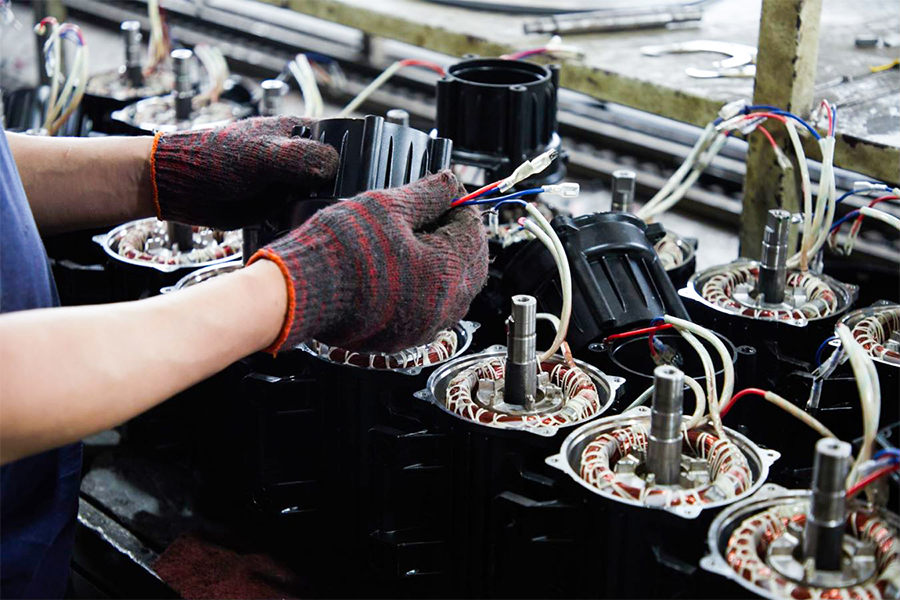
2. Efficiency under Variable Loads
Asynchronous Motors: These motors achieve peak efficiency near rated load. Under light or fluctuating loads, efficiency decreases due to slip and rotor losses.
Permanent Synchronous Motors: PMSMs maintain high efficiency across a broad range of load conditions. The permanent magnets in the rotor reduce electrical losses, maintain a higher power factor, and optimize energy consumption even under partial load, which is particularly valuable in variable-load industrial systems.
3. Torque and Speed Stability
Asynchronous Three Phase Motor: Torque slightly decreases as load increases, and speed is not ideally constant. In applications such as general-purpose pumps or compressors, minor variations are manageable.
Permanent Synchronous Motor: Torque is stable and speed remains fully synchronized with the stator field. This ensures smooth operation for high-precision machinery, automated assembly lines, and coordinated multi-motor systems.
4. Industrial Applications
Variable Load Scenarios: PMSMs are ideal for chemical sprayers, fluid pumps, or air handling units where load conditions frequently change. They provide smooth operation, precise control, and consistent output.
Steady Load Applications: Asynchronous motors are suitable for heavy-duty fans, compressors, mixers, or general-purpose machinery where loads remain relatively constant.
Coordinated Systems: In packaging or assembly lines with multiple motors, PMSMs ensure synchronized movement across all units, reducing downtime, misalignment, and product waste.
5. Control and Maintenance Considerations
Asynchronous Motors: Simple construction allows for easy maintenance. Variable load operation may require soft starters or variable frequency drives (VFDs) to improve energy efficiency and reduce mechanical stress.
Permanent Synchronous Motors: Require precision controllers or VFDs for startup, acceleration, and speed regulation.
6. Performance in Multi-Motor Systems
Asynchronous Motors: Small speed variations under load changes can accumulate in systems with multiple motors, result in timing mismatches in conveyors or synchronized equipment.
Permanent Synchronous Motors: Maintain uniform speed and torque across all units, ensuring accurate synchronization in complex automated processes, improving production quality and reducing downtime.
Energy Implications: PMSMs typically reduce total energy consumption in multi-motor systems due to higher efficiency under varying loads and better power factor performance.
7. Practical Considerations and Recommendations
Selecting Motor Type: Evaluate load patterns, precision requirements, and energy efficiency goals. PMSMs are preferable in variable-load or precision applications, while asynchronous motors are cost-effective and reliable for steady-load operations.
Hybrid Approach: Some industrial systems combine PMSMs for precision tasks and asynchronous motors for general load handling, balancing cost, energy efficiency, and performance.
Vendor Selection: Choosing a manufacturer with expertise in both motor types, like Zhejiang Hechao Motor Co., Ltd., ensures that the selected motor meets performance requirements and operational reliability.